If you missed the opening post for this series, ‘Blinding Lights,’ this is it linked here.
For this FM27 series, each post is split in two. The first half is the story: a tongue-in-cheek, noir-inspired snapshot from a moment in the manager’s journey. The second half takes the form of an Athletic-style feature from theangrylinesmen, my fictional football publication; covering results, transfers, analysis and the wider narrative around the club and other news from the footballing world.
The Story
The dampness of an earlier downpour still lingered in the night. Water clung to the metal roofs of Stade Bauer and glistened beneath the floodlights. The pitch shone dark green beneath the haze. It was only a pre-season friendly but there was something unique in the air.
CMS Oissel were visitors from the lower reaches of French football. The result would be forgotten by autumn. The goals would disappear into highlight reels nobody would watch twice. Yet 9,369 people had filled Bauer’s ten thousand seats to witness it. Almost a sell-out. For a warm-up match. Enzo Scutari found the number difficult to comprehend.
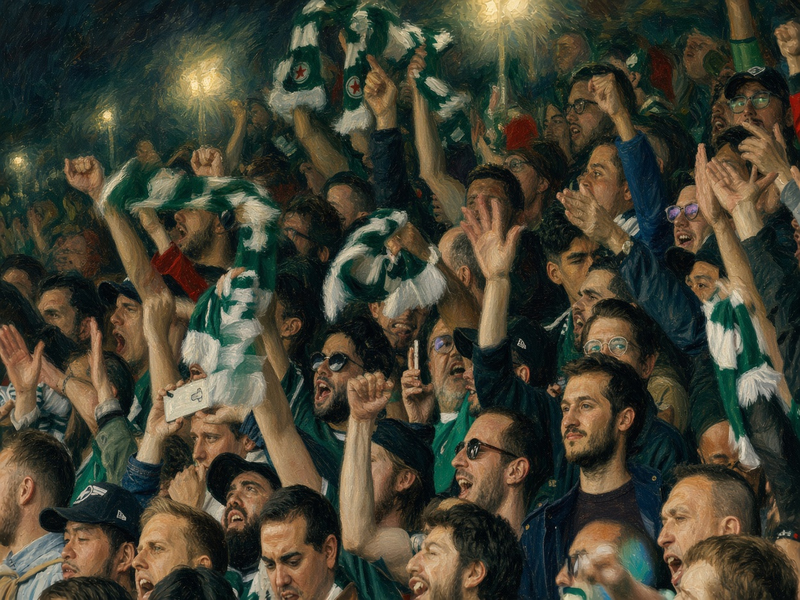
He stood in his technical area before kick-off and watched the supporters arrive in waves. Scarves draped around necks despite the warm evening air. Flags hanging from railings. Beer cups balanced on concrete ledges worn smooth by generations of hands. They had come because this mattered to them. Not necessarily the result. Definitely not the opposition. Their club, on opening night.
The game itself unfolded beneath a soundtrack of constant noise, though Scutari stopped noticing the moment the referee’s whistle kicked off the action.
For ninety minutes he prowled the touchline like a man pursuing a debt. Every misplaced pass earned an explosion of gestures. Every successful press brought an approving nod before he was shouting at the next phase of play. His coat flapped behind him as he marched from one edge of the technical area to the other. At times he seemed less manager than conductor, arms slicing through the damp night air as he attempted to orchestrate movements only he could fully see.
Red Star led. Then they controlled. Then they won. A comfortable 3-1 scoreline against modest opposition. The sort of victory most managers would file away without a second thought. Scutari looked exhausted by it.
Because the match was never really about Oissel. It was about glimpses.
A passing combination that appeared exactly as it had on the training ground. An attacking midfielder tracking back thirty yards without being asked. A defender stepping forward at precisely the right moment. The small fragments of an idea becoming visible.
Football managers survive on moments like that. Tiny confirmations that they are not chasing ghosts.
When the final whistle sounded, a cheer rolled around Stade Bauer. A strange cheer. Too loud for a friendly. Too warm. Too invested.
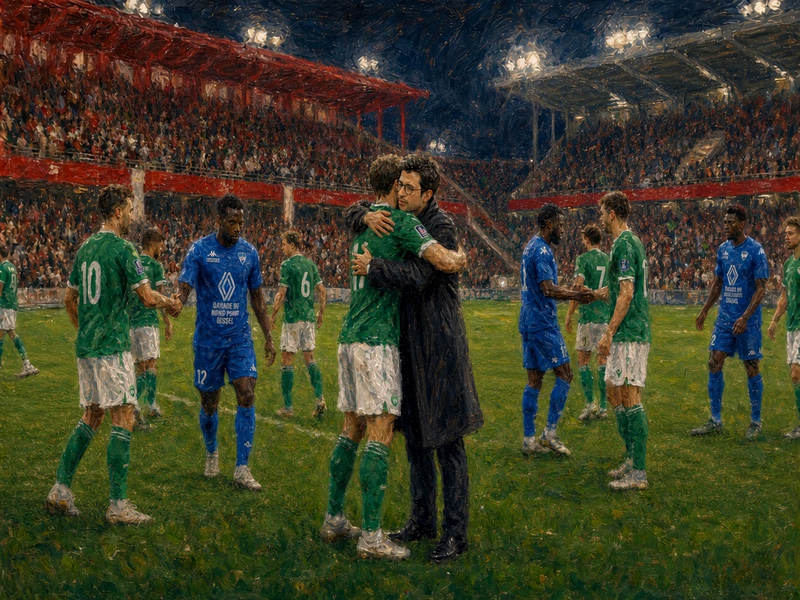
The players drifted toward the centre circle, sweat-soaked and smiling. Scutari reached the first of them and wrapped him in an embrace. Then the second. Then the third. One by one. Every player.
There was something almost paternal about it. Not the detached congratulations of a manager protecting professional boundaries. Something deeper than that. As if he was thanking them for believing in the same thing he did. As if each embrace was a small acknowledgment of early trust repaid.
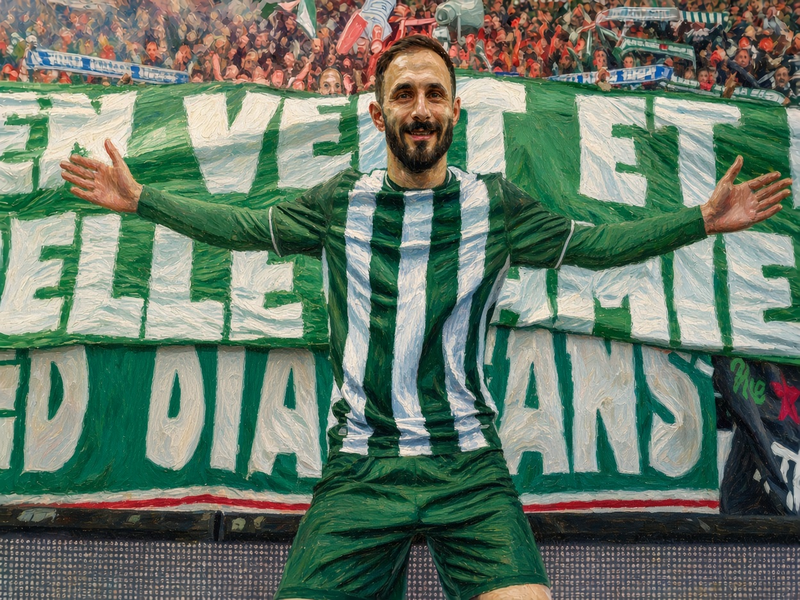
The supporters watched from the stands. Many remained long after they might reasonably have left. Scutari eventually turned toward them. A single punch in the air was enough to trigger a roar from the terraces. Another followed. Then another.
The noise washed across the pitch and echoed beneath the steel roof. For a moment he simply stood there.
The stadium lights reflected in puddles near the touchline. Flags hung motionless in the still night air. Above the terraces, apartment blocks loomed through the darkness. Beyond them, unseen but ever-present, lay Paris. Rich Paris. Famous Paris. The Paris that rarely noticed places like Saint-Ouen until they became impossible to ignore.
Scutari pulled his coat tighter around himself. He had arrived expecting a football club. Already he had found something else. Something older. Something heavier. As the players disappeared down the tunnel, the chants continued to float through the darkness.
Almost ten thousand people had come to watch Scutari’s first pre-season match against lower-league opposition. To an outsider, the number made little sense.
Standing alone beneath the floodlights, listening to the last echoes ricochet around Stade Bauer, Enzo Scutari realised it made perfect sense.
It was devotion built on belief. And belief, he knew better than most, could carry a crowd to heaven or drag a man into ruin.
The start of an era: Enzo Scutari’s ‘in-tray’ at Red Star FC
The first thing to understand about Red Star is that Enzo Scutari has not walked into a crisis. The club’s finances are stable enough, the hierarchy above him is not demanding miracles, and the squad he inherits contains a core of experienced Ligue 2 players alongside younger talents capable of growing into something more.
There is no scorched-earth rebuilding project awaiting him in Saint-Ouen. Equally, there is no lavish budget or collection of future internationals waiting to be unleashed. Red Star occupy that awkward middle ground familiar to much of French football: ambitious enough to dream, realistic enough to understand the ladder ahead.
There’s currently no Director of Football at Red Star, but if the rumours are true, they are in the process of employing one. How much of a say Scutari has in this appointment remains to be seen.
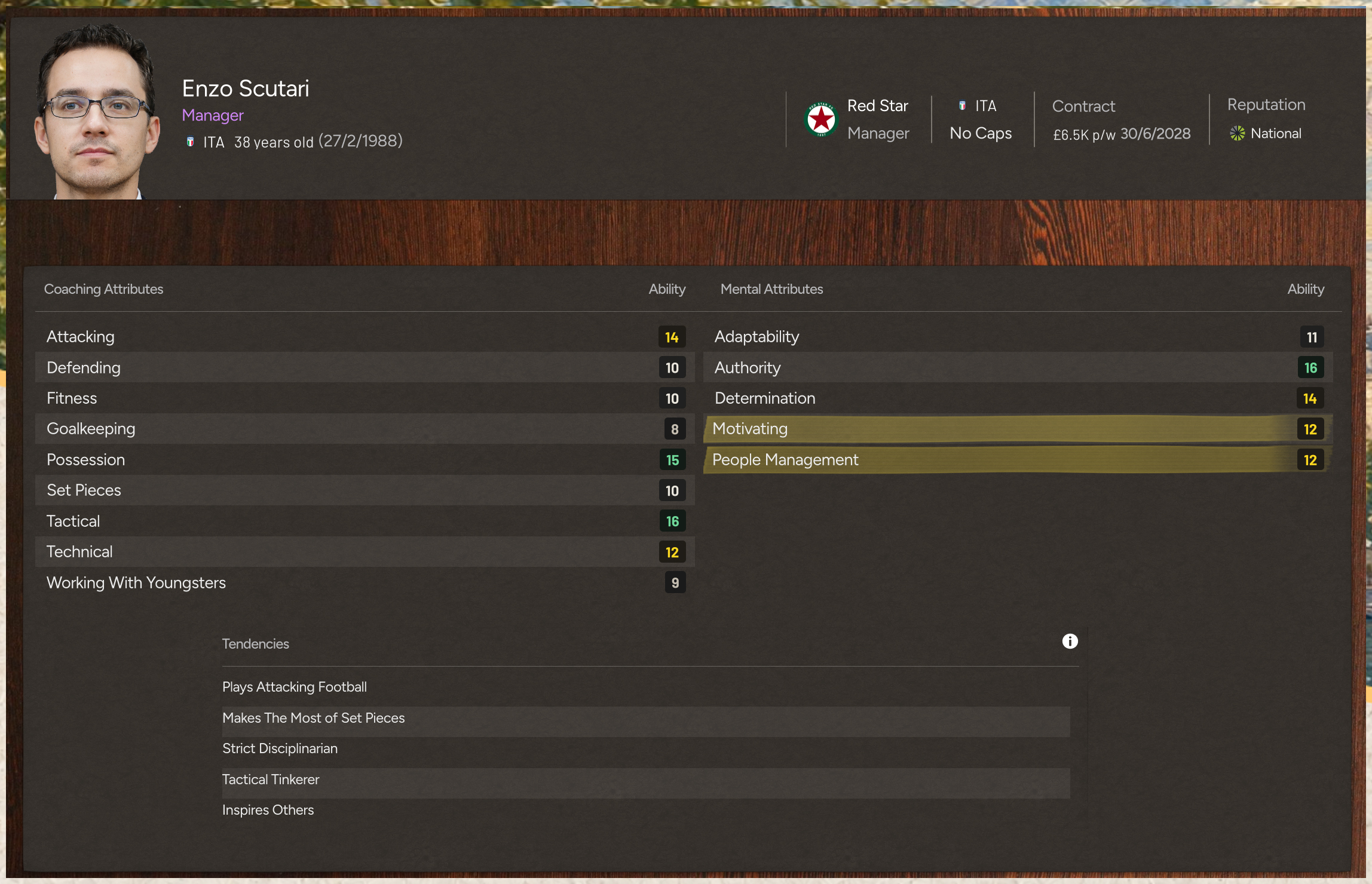
Scutari arrives with considerably less fanfare than many of his contemporaries. Outside the game’s obsessives, his name rarely dominates discussions. Yet those who followed his work at Sampdoria know why Red Star turned towards him. His reputation was not built on celebrity or silverware, but on structure, organisation and a willingness to develop a side around the strengths already available. In that regard, Saint-Ouen may prove an ideal fit. Red Star have always prized collective effort over individual stardom, and Scutari’s football appears cut from a similar cloth.
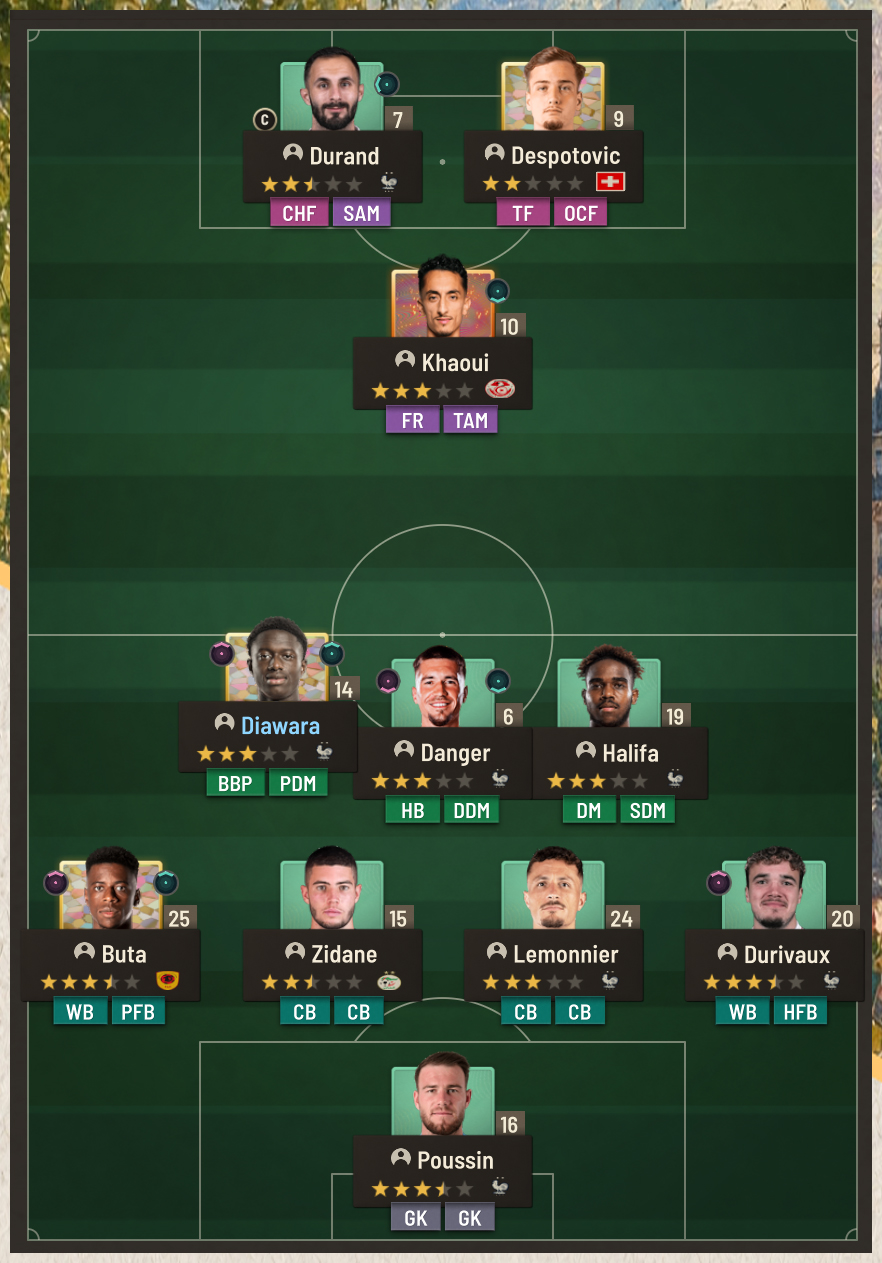
A glance at the squad immediately reveals the logic behind his preferred shape. The strongest area of the team is not out wide but through the middle. Islamdine Halifa, Mahamadou Diawara and Bradley Danger provide a blend of industry, intelligence and control that should allow Red Star to dominate central areas against much of Ligue 2. Ahead of them, Saïf-Eddine Khaoui has the technical quality to operate as the link between midfield and attack, while Damien Durand and Ilija Despotovic offer contrasting qualities at the top of the pitch. The temptation for many coaches would be to force the squad into a fashionable front three. From the tiny glimpse we’ve seen so far though, Scutari appears more interested in placing his best players in their strongest positions.
Club captain Damien Durand is entering his seventh season at Stade Bauer, Ilija Despotovic is an exciting prospect who has already been handed the number nine shirt, and if Elyaz Zidane has inherited at least 25% of his famous father’s talent as a fair share alongside brothers Enzo, Luca and Théo, he could go very far indeed.
The result is expected to be a narrow 4-3-1-2, a system designed less around width and more around territorial control. Rather than stretching opponents with wingers, Red Star will look to overwhelm the centre of the pitch before releasing attacks quickly through Khaoui and the front pair. Width, meanwhile, is delegated almost entirely to the full-backs. Leonardo Buta and Dylan Durivaux possess the energy and athleticism to shuttle relentlessly between both boxes, providing the attacking outlets that the formation otherwise lacks. It is not possession football for possession’s sake. The objective is to recover the ball, play forward early and attack before opponents can settle into shape.
That approach feels particularly suited to the realities of Ligue 2. Matches are often decided not by technical superiority but by organisation, transitions and physical intensity. Red Star’s midfield should be capable of winning those battles. The question is whether the rest of the squad can consistently support them. For all the quality in central areas, there remains a suspicion that the defence lacks a truly commanding presence. Pierre Lemonnier provides experience, while Elyaz Zidane offers athletic potential, but the back line could still benefit from a leader capable of organising the defensive structure and dominating penalty boxes.
The centre-forward position may also warrant attention in January 2027 when the next window Scutari could recruit in opens. Despotovic looks an accomplished finisher despite his tender years, yet there remains room for a more complete profile: a forward capable of stretching defences, pressing aggressively and contributing between the lines. The same can be said for creativity from deeper wide areas. In a system so dependent on the full-backs, depth and quality in those positions are not luxuries but necessities.
Viewed in isolation, none of those issues are fatal. In fact, they help explain why the Red Star job appealed in the first place. Scutari is not inheriting a squad broken beyond repair. He is inheriting one that appears only a few pieces short of becoming genuinely competitive. The challenge of his first season should therefore be less about revolution and more about refinement.